
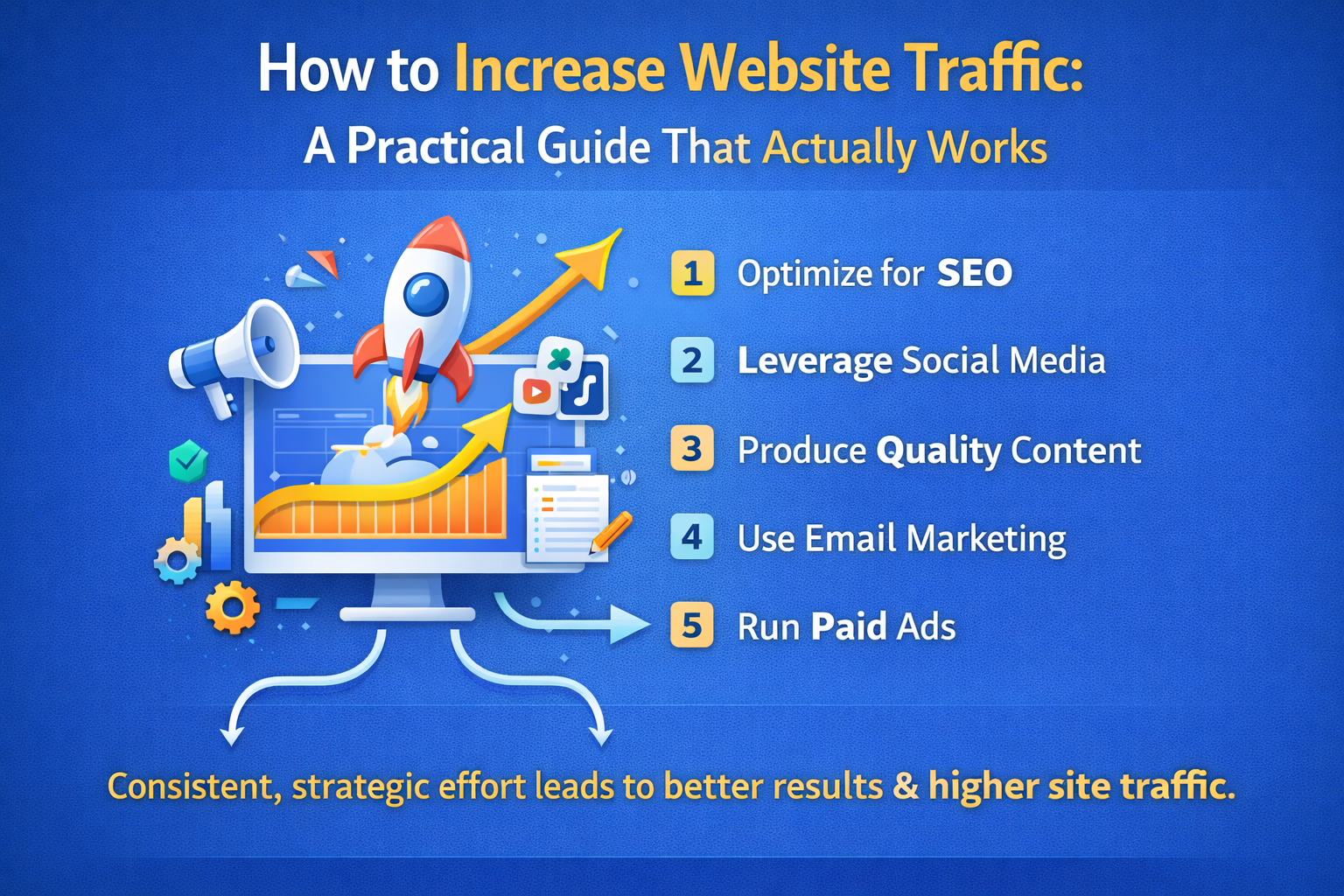
Getting traffic to your website sounds simple. Post content. Share it. Wait for visitors.
But if you’ve tried that, you already know it doesn’t work that way.
Traffic is not random. It’s not luck. And it’s definitely not about posting more and hoping something goes viral.
It’s about building systems that bring people to your site consistently.
In this guide, I’ll break down what actually drives website traffic today, what most people get wrong, and how to build a simple, repeatable strategy that works.
Let’s start with something important.
First: What “Traffic” Really Means
When people say they want more traffic, they usually mean one of three things:
- More people finding them on Google
- More visibility on social media
- More potential customers discovering their business
All of these matter. But not all traffic is equal.
1,000 random visitors who leave in 10 seconds are less valuable than 100 people who actually care about what you offer.
So instead of chasing numbers, focus on relevant traffic.
That mindset shift changes everything.
1. Build Around Search Intent, Not Just Keywords
Most SEO advice starts with keywords. That’s fine, but it’s incomplete.
The real question is: What is someone trying to solve when they search?
For example:
- “Best running shoes for flat feet” → they want recommendations
- “How to start a blog” → they want step-by-step instructions
- “Email marketing software pricing” → they are close to buying
If your content doesn’t match the intent behind the search, it won’t rank well. And even if it does, people won’t stay.
How to apply this:
- Search your topic on Google.
- Look at the top five results.
- Notice the format. Are they lists? Guides? Reviews? Tutorials?
- Create something better, clearer, and more complete.
Don’t try to fight the format Google is already rewarding. Align with it.
2. Write Fewer, Better Articles
One of the biggest traffic mistakes is publishing too much low-quality content.
Ten shallow posts won’t outperform one detailed, useful guide.
Instead of asking, “How many posts should I publish this week?” ask:
“Can this be the best resource on this topic for my audience?”
Depth wins. Clarity wins. Specificity wins.
A strong 2,000-word article that solves a real problem will outperform five 500-word filler posts.
Quality compounds. Weak content disappears.
3. Create Content Clusters
If you want serious traffic from search engines, stop writing random articles.
Start building clusters.
A content cluster looks like this:
- One main pillar page (broad topic)
- Several supporting articles (specific subtopics)
- All internally linked together
Example:
Pillar: “Complete Guide to Email Marketing”
Supporting posts:
- How to Write Email Subject Lines That Get Opened
- Best Time to Send Marketing Emails
- Email Automation for Beginners
- Email List Building Strategies
When Google sees multiple connected articles around the same topic, your authority increases.
It also keeps readers on your site longer, which improves engagement.
Clusters turn your website into a resource, not just a blog.
4. Use Internal Linking Strategically
Internal links are one of the simplest traffic tools, yet most people ignore them.
Every time you publish a new article, link to:
- 3–5 relevant older posts
- Your main service or product pages where appropriate
This does three things:
- Helps search engines understand your site structure
- Passes authority between pages
- Keeps visitors browsing
Think of internal links as pathways. If your site has no pathways, people leave.
5. Optimize for Click-Through Rate
Ranking on Google is not enough. People need to click.
Your title and meta description matter more than you think.
Compare these:
“Email Marketing Tips”
vs
“7 Email Marketing Mistakes That Are Killing Your Sales”
The second one is specific. It promises value. It creates curiosity.
You don’t need clickbait. But you do need clarity and relevance.
A few ways to improve click-through rates:
- Use numbers
- Be specific
- Highlight outcomes
- Address pain points directly
More clicks without higher rankings means more traffic with the same effort.
6. Refresh Old Content Instead of Starting Over
Many websites have hidden traffic sitting in old posts.
Before creating something new, check your analytics.
Look for:
- Articles ranking on page 2 of Google
- Posts that used to perform well but declined
- Content that’s outdated
Update them.
Add depth. Improve structure. Add current examples. Strengthen headlines. Improve formatting.
Refreshing old content is often faster than creating new content from scratch. And the traffic boost can be significant.
7. Use Social Media as Distribution, Not Storage
Posting content on social media is not the same as building traffic.
Social platforms should funnel people to your website, not replace it.
Instead of just sharing links, try this:
- Break your article into short insights
- Turn sections into threads or carousel posts
- End with a clear call to action
For example:
“Want the full step-by-step strategy? I wrote a detailed guide here: [link]”
Consistency matters more than virality.
One viral post may spike traffic for a day. A consistent posting system builds it for months.
8. Build an Email List Early
Search traffic is powerful. Social media traffic is useful.
But email traffic is owned.
If Google updates its algorithm, rankings shift.
If a social platform changes reach, visibility drops.
Your email list stays.
Every blog post should have:
- A simple email opt-in
- A relevant lead magnet if possible
- A clear benefit for subscribing
Even a small list of 500 engaged subscribers can generate more consistent traffic than thousands of random visitors.
9. Collaborate for Faster Growth
If you want traffic faster, borrow audiences.
Ways to do this:
- Guest post on related blogs
- Appear on podcasts
- Write collaborative articles
- Exchange newsletter mentions
Instead of waiting for people to discover you, show up where they already are.
Choose collaborations where the audience overlaps with yours. Relevance matters more than size.
10. Track What Actually Works
You don’t need complicated analytics. But you do need feedback.
Watch:
- Which posts bring the most traffic
- Which keywords are driving impressions
- Which pages convert visitors into subscribers or customers
Then double down.
If tutorials outperform opinion pieces, create more tutorials.
If long guides outperform short posts, go deeper.
Let data guide direction.
11. Avoid These Common Traffic Traps
Let’s clear up a few myths.
Trap 1: “I just need to post more.”
Volume without strategy wastes time.
Trap 2: “SEO is dead.”
It’s not dead. It’s competitive. That’s different.
Trap 3: “Social media followers equal traffic.”
Many accounts with thousands of followers struggle to send visitors to their websites.
Trap 4: “Paid ads will fix everything.”
Ads can amplify a working system. They won’t fix a broken one.
Traffic is a long-term asset. Treat it like one.
A Simple 90-Day Traffic Plan
If you’re starting from scratch, here’s a practical plan.
Month 1:
- Choose one core topic
- Research 10 strong subtopics
- Publish 4–6 high-quality articles
- Set up basic SEO structure
- Start collecting emails
Month 2:
- Publish 4 more articles
- Improve internal linking
- Start sharing consistently on one social platform
- Reach out for 2–3 collaboration opportunities
Month 3:
- Update and improve top-performing posts
- Build one lead magnet
- Strengthen email sequences
- Analyze what’s gaining traction
This approach builds a foundation instead of chasing trends.
The Real Secret to Traffic
There isn’t one tactic that changes everything.
Traffic comes from:
- Clear positioning
- Strong problem-solving content
- Consistency
- Smart distribution
- Continuous improvement
It’s less about hacks and more about systems.
Most people quit before the compounding effect begins.
Search rankings take time. Authority takes time. Trust takes time.
But once momentum builds, it builds faster.
Final Thoughts
If you want more traffic, stop chasing shortcuts.
Focus on:
- Helping a specific audience
- Solving real problems
- Creating depth over noise
- Building systems instead of posting randomly
Traffic is not about being everywhere.
It’s about being useful in the right places.
Start with one topic. Build authority around it. Connect your content. Improve what works.
Do that consistently, and traffic stops feeling random.
It starts feeling predictable.
And that’s when your website becomes an asset instead of just another page online.

